
4. A Pilgrimage

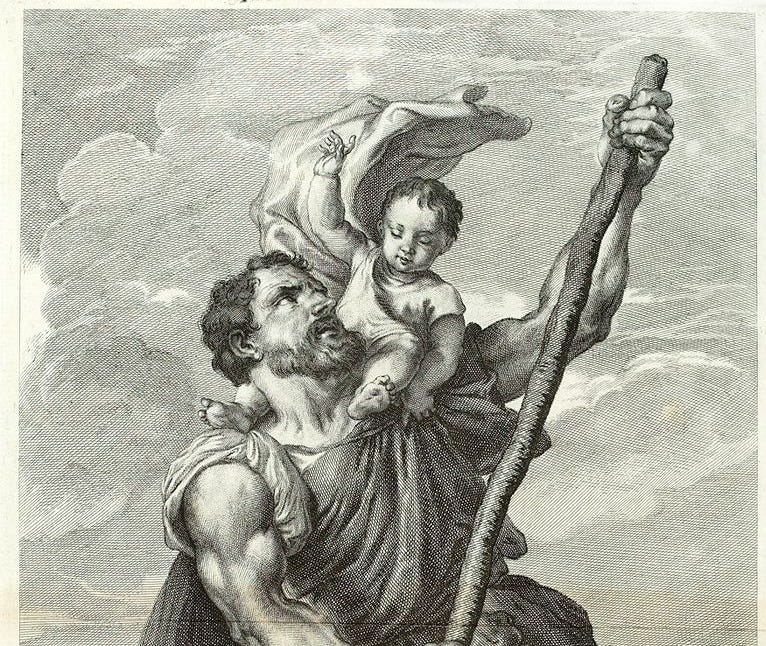
Travelers used to keep a Saint Christopher’s medal—that silver relief of the Saint’s oversized head, his sprouting staff, and the baby Jesus on his shoulders, worn smooth from repeated fingerings. “Protect us”, the prayer uttered so many times it can’t possibly still merit a response. Saint Christopher, the Christ-bearer, patron of mariners, protector against toothaches, hailstorms, lightning, pestilence, and sudden death. If ever I wanted a patron saint, this was the one for an anxious mind like mine.
Christopher (Reprobus) was a Canaanite and over seven feet tall. Sometimes he is depicted as a Cynocephalus, or one of the dog-headed people who ate the flesh of humans. As a youth, he was a mercenary following the strongest leader he could find. For a time, that leader was the devil, until he saw this master avoid a roadside cross in fear of Christ. Then he abandoned the devil and pledged to follow the Son of God.
Eventually, he came upon a hermit and asked that hermit to help him live in a way that would serve Christ, his new master. The hermit instructs him to live next to a nearby river and help travelers to cross the river, preventing them from drowning. This is his sacrifice. To serve Christ, a man of combat puts down his sword and picks up a sprouted staff and carries the weak across a river. Christopher is a foreigner, an outsider, the beast, the skin-wearer, and the protector.
One day, Christopher transports a baby on his shoulders and feels the weight of the world. He is the bearer of Christ, along with all the world’s pains and sorrows. On top of the world stands a man, Saint Christopher, supporting Christ on his shoulders, and Christ himself carrying that entire world. It’s an arresting image—like an Escher print.
As with the tale of Saint Christopher, the American story is full of mess and contradictions. America is a story of traditions, but also a willingness to move on, unencumbered, into open spaces. It is the hope of new ideas, new places, and new people, but with a healthy dose of immigrant skepticism of change. Of course, it is also the ugly side of escaping from one tyranny only to set up new boundaries that hem other people in or out. And it is the evolving, but ever-present, fear of the “other”, the new person, and the shameful practices that are always nearby when that fear is at its zenith. My own family story is born out of that complexity.
Many of my ancestors in the American colonies were reforming Protestants—Congregationalists, Presbyterians, and Quakers. According to those beliefs, the chosen people are all saints. But in the West Indies, where my father’s family landed, it was Anglican. When the Anglican Church broke with Rome, it retained many traditions of the Catholic Church, including its panoply of Saints. Those Saints humanized the church. The Saints were relatable. The Anglican calendar retains feast days that the Roman Catholic Church has since abandoned.
Saint Christopher was removed from the Catholic Church’s worldwide calendar in 1969. And it turns out Saint Christopher was never officially canonized. That practice post-dated Christopher’s time. Instead, Christian communities merely claimed their Saints, and over centuries the liturgical calendar had gotten, well, a bit cluttered. So, the Vatican swept aside some old furniture.
Why get rid of the patron saint of mariners? My ancestors, like every European who came to this country before the twentieth century, arrived by boat. Once here, their daily lives remained connected to water. Roads in colonial New England were few and treacherous. The quickest and safest way to get anywhere was by boat. And south in the West Indies, where other parts of my family ended up, they were connected only by water to a broad Atlantic-wide society of trade and commerce. It is difficult to fully appreciate the importance of maritime transport to our relatively recent past.
I spent two years in my twenties building wooden boats in a small commercial boat shop. Each day at work, we would do some new thing for the first time. In a professional shop with tight margins and schedules, there is little room for mistakes. For a working boat, it is possible to end up with a finish that is too refined. For example, many traditional Shetland and Norwegian fishing boats were covered with a mix of linseed oil and pine tar. The oily soup would mix with dirt and seawater, turning nearly black. When the finish had seen some weather, a new coat could be splashed right over the old. Over time, layers would build up to a substantial thickness, harden in the elements, and craze. Older boats look as if they have been through fire.
I built myself a boat for the distraction. And at the same time, I started researching my family history for the same reason. After my mother’s long illness and death, I had turned inward to the point of shuttering out the rest of the world. Though if I’m honest, I’d already begun retreating into myself before her death.
I was in the same state of mind that made Ishmael look for a ship. Early in Melville’s novel, when the Pequod departs, Ishmael notices at the helm a sailor he has seen in town who had recently returned from another three-year sea voyage. “The land seemed scorching to his feet.” If this sailor shuns the comforts of land, it is because those comforts can be hazardous.
But in that gale, the port, the land, is that ship’s direst jeopardy; she must fly all hospitality; one touch of land, though it but graze the keel, would make her shudder through and through. With all her might she crowds all sail off shore; in so doing, fights ’gainst the very winds that fain would blow her homeward; seeks all the lashed sea’s landlessness again; for refuge’s sake forlornly rushing into peril; her only friend her bitterest foe!
Unlike Ishmael and the Pequod, I wasn’t going anywhere. Instead, I started disinterring generations of my family, extracting them from documents and digital records. And with each step I take backward in time, the scope of that labor broadens—two parents, four grandparents, eight great-grandparents—and the transits into the past multiply.
I was trying to find my place in a larger story, to follow the meandering path of my family as each generation reshaped itself, often leaving another not-quite-forgotten life behind. The journey of that American family—from Puritan, to Quaker, to Presbyterian, to Philosopher, to Physicist, to Mathematician, and a half dozen similar paths from deep conviction to general skepticism— mirrors our country’s ideological narrative. It starts with religious independence, embraces enlightened humanism, elevates to singular importance the rational mind, celebrates the transcendental nature of the human soul, and eventually is mired in the deep and obscuring soils of intellectual relativism.
So began a journey, visiting familiar, and less familiar, places—early New England, including Salem and its notorious witch trials; New London and its burgeoning trade with the plantation economies of the West Indies; the isolated island of Nantucket and its Quaker beginnings that both relied upon and opposed chattel slavery; the shores of West Africa; Jamaica; and the islands of Grenada, St Kitts and Nevis, and the sugar estates that created so much wealth back in Europe.
I wanted to look beneath the surface stories we tell ourselves about where we come from and who we are. Soon, I found I was wandering through a sea of vital records and neglected documents. And, at times, I got diverted along the way. This is that story.